
Pharmacy Technician
Online theory with in-person labs
Up to $36.26/hr in BC, up to $35.83/hr in Saskatchewan, up to $41.35/hr in Alberta
For the upcoming program start, all applicants are eligible for a $1,500 tuition discount.* Current healthcare employees are eligible for a $2,000 tuition discount for the upcoming program start.*
Start: March, June, & October
54 weeks with hands-on lab training and local practicums
The Canadian Council for Accreditation of Pharmacy Programs (CCAPP)
Surrey
About the Career
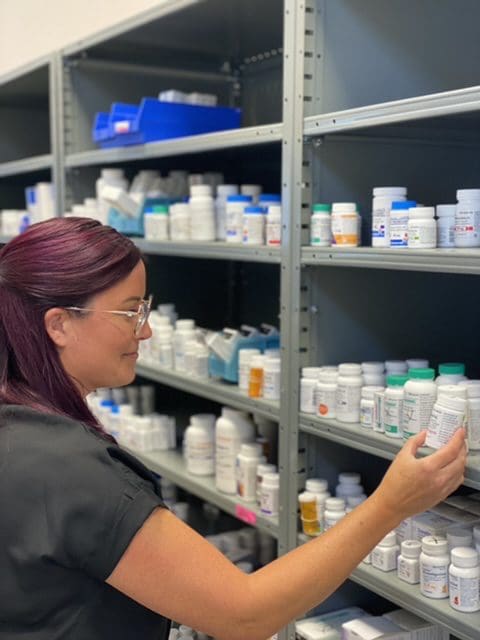
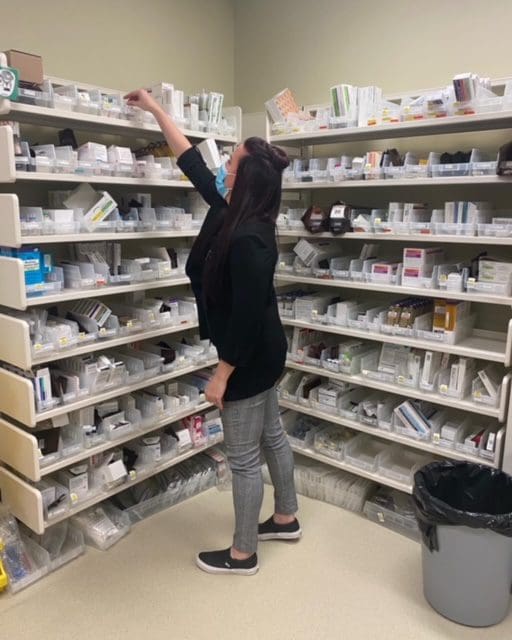
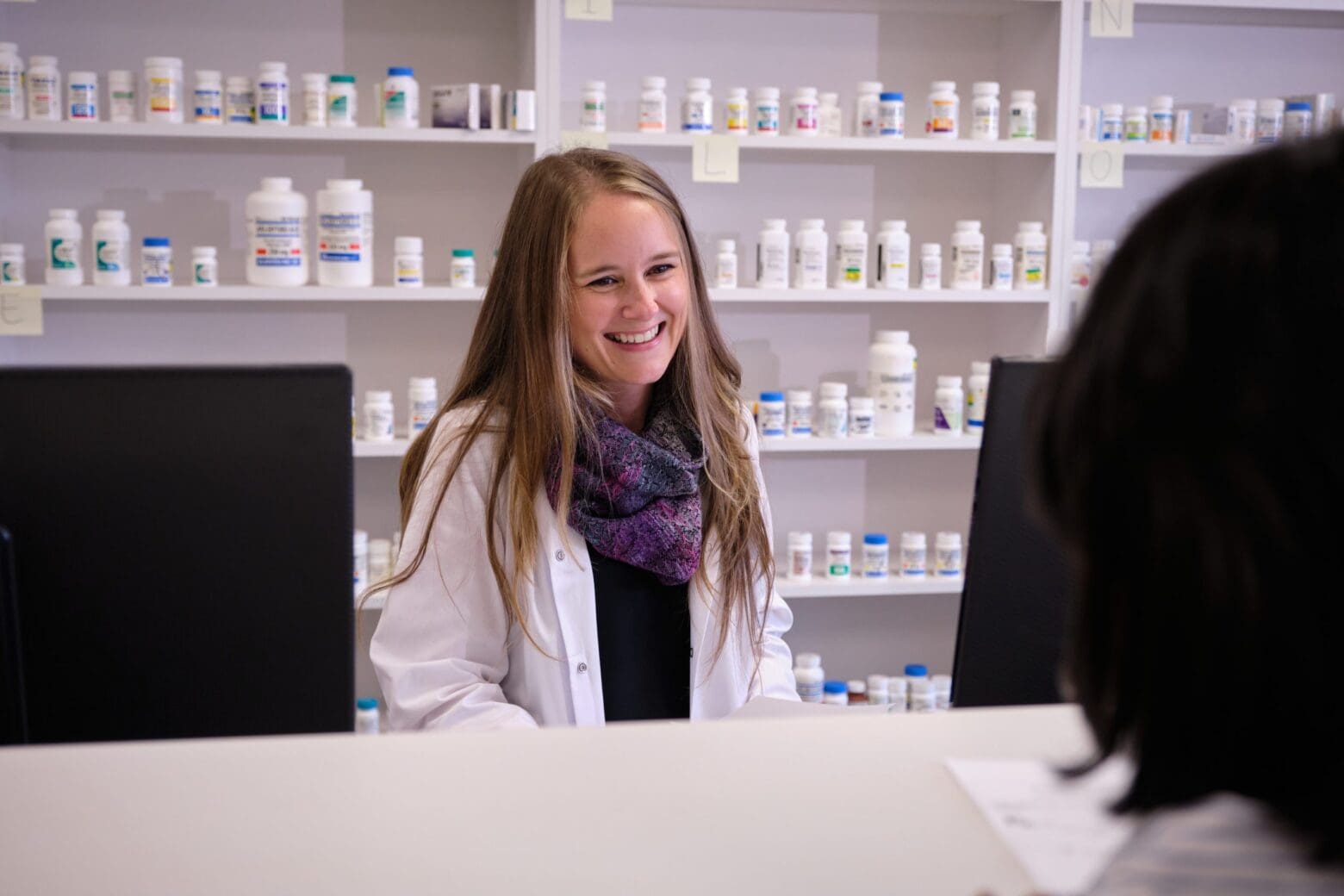
Pharmacy Technicians are a critical part of the health care team. They work closely with Pharmacists and ensure that the highest standards of quality and accuracy are met in the compounding and dispensing of prescription medications. Their scope of practice includes receiving and transcribing verbal prescriptions, transferring prescriptions, and performing final checks.
Becoming a Registered Pharmacy Technician allows you to operate at an expanded scope of practice and increases your earning potential. Pharmacy Technicians work with precision and attention to detail to ensure patient safety and optimal healthcare outcomes.
Please note: This program is not eligible for the post-graduate work permit program.
Scholarships
General Pharmacy Technician Discount
For the upcoming program start, all applicants are eligible for a $1,500 tuition discount.
Healthcare Employee Discount
Current healthcare employees are eligible for a $2,000 tuition discount for the upcoming program start.
*Conditions apply and offers cannot be combined.
Potential Employers
Hospital pharmacies
Community pharmacies
Compounding and other specialty pharmacies
College of Pharmacists in your province
Insurance companies offering drug coverage plans
Provincial government drug coverage plans
Colleges offering Pharmacy Technician instruction
About the Program
Our combined delivery Pharmacy Technician program has full accreditation by the Canadian Council for Accreditation of Pharmacy Programs (CCAPP).
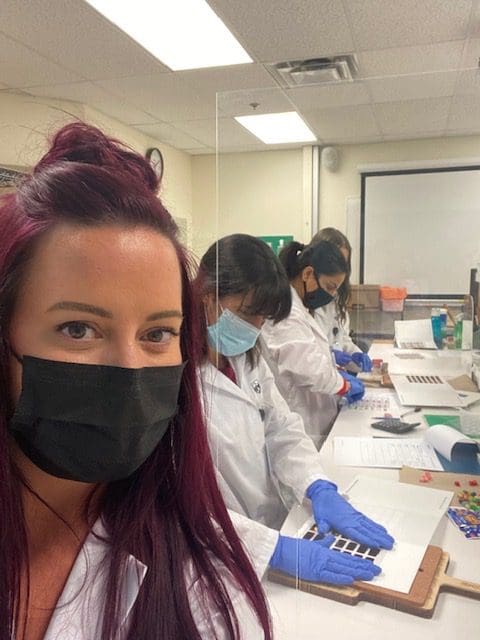
This program at Stenberg College is designed to prepare students for Pharmacy Technician positions in community or hospital pharmacies. In our combined delivery program, instructors facilitate learning in an interactive online environment. Hands-on skills are developed in the lab setting and clinical competencies are mastered at affiliated clinical partner sites (hospitals and community pharmacies). This delivery allows students to pursue the majority of their program in their home communities, with travel/relocation required only for short periods of time to complete program orientation, lab blocks, and clinical requirements.
It's Stenberg College's mission to offer an exceptional career-oriented Pharmacy Technician Program with a goal to prepare graduates who:
- Demonstrate the knowledge base, skills, and attitudes consistent with industry expectations for entry-level employment. Graduates will be able to meet competency requirements set out by the National Association of Pharmacy Regulatory Authorities (NAPRA).
- Excel in the exams required to become a Regulated Pharmacy Technician and qualify for membership with the College of Pharmacists in their province.
- Gain employment in the field within 6 months of graduation.
Program Features:
- Full CCAPP accreditation
- Combined online theory and hands-on lab training
- Community and hospital pharmacy practicums
- Preparation for NAPRA certification exams
- Lab training in Surrey
- Tuition discounts available (up to $2,000)
Related Programs
Accreditation and Recognition
Stenberg College is designated by the BC government's Ministry of Advanced Education through the Private Training Institutions Regulatory Unit (PTIRU). This program is approved by the PTIRU of the Ministry of Post-Secondary Education and Future Skills. PTIRU is responsible for setting standards of quality and ensuring consumer protection. Stenberg College has also received the BC government's Education Quality Assurance (EQA) designation, which is BC's brand or "seal" of quality post-secondary education for public and private institutions.
Admission Requirements
PROGRAM-SPECIFIC ACADEMIC ADMISSION REQUIREMENTS
- High School graduation or Adult Graduation program
- Any English Grade 12 or higher (min. C grade) or the following in lieu: Acceptable score in one of the approved NAPRA tests as noted below Accuplacer: Reading 240, Writing 240 and WritePlacer 4 CLBPT: No component less than 7 Duolingo overall score of 115 and no component less than 95
- Biology or Human Anatomy & Physiology Grade 12 or higher (min. C grade)
- Math Grade 12 or higher (Principles, Foundations, Applications) or Grade 11 Pre-Calculus (or Principles previous stream) (min. C grade)
- Chemistry Grade 11 or higher (min. C grade)
- Typing speed of 30 net words per minute
- Successful completion of the online Computer Skills Entrance Test (minimum 70%)
- Completion of Stenberg College informational interview as part of the admissions procedure
- Completion of a Criminal Record Consent Form under the Criminal Record Review Act as part of the admissions procedure
Stenberg College Pharmacy Technician program applicants may write challenge exams or take upgrading courses to meet academic admission requirements for English 12, Bio/A&P 12, Math 11, Chemistry 11 which must be passed with the above-noted minimum grades. Any post-secondary level English, Math, Anatomy & Physiology, and Chemistry courses are also acceptable.*Evidence may be demonstrated by providing a high school transcript, completion of a provincial Adult Graduation program, permanent student record, GED, or by providing international education credentials confirming medium of instruction in English as recognized through WES, ICES, or IQAS. Alternatively, where 3 years of post-secondary education are being determined based on credits, it is expected that the student has taken studies with a minimum of 18 credits per academic year and/or indicates completion of a minimum of 54 credits in total. For those with a BC High School Transcript issued prior to the 2004 graduation program, and only reflecting completion of Grades 11 and 12, an English Language Attestation form can be completed to confirm completion of 3 years of full-time instruction in English.
LANGUAGE PROFICIENCY REQUIREMENT (LPR)
For regulated programs, language proficiency requirements, including permitted tests and scores dictated by the regulatory body, will supersede all else. The Pharmacy Technician program is accredited by CCAPP and therefore, English Language Proficiency Requirements must be met through standardized tests as defined by NAPRA.
Pathway I: Education as Evidence of Language of Proficiency
Graduation from a high school, CEGEP (general and professional teaching college in Quebec), community college, private career college or university program located in Canada, if the program was of at least three years* duration and was provided in the language required for licensure, with successful completion of three consecutive English or French language courses, depending on the required language. Second language or additional language courses are not acceptable as evidence (Requirement 4.4, page 6).
Pathway II: Language Proficiency Tests as Evidence of Language of Proficiency
- IELTS Academic: Reading 7.0, Listening 7.0, Speaking 7.0, Writing 6.5
- OET: Reading B, Listening B, Speaking B, Writing C+
Physical Requirements
Please note: Applicants must have acceptable levels of manual dexterity, hand strength and the ability to work while standing and walking for long periods. Severe latex allergies may be a problem.
Student Diversity
Stenberg supports diversity in our student population, and we hold one seat per program for a self-identified Indigenous applicant who meets admission requirements. If the seat remains unfilled at 12 weeks prior to the program start, the seat will be released and offered to other qualified applicants.
Program Courses
Orientation & Student Success Skills
This course will provide a comprehensive orientation to Stenberg College and the program you have enrolled in. As with all new things, there will be some challenges and excitement; this course will explore transitioning as a college student, review learning styles, enhance critical thinking, and familiarize you with the available resources. This course covers student success skills where you'll learn effective study habits (specifically aimed at improving both reading and writing skills) based on your own personal learning style. Life skills exercises are also integral to the course, teaching communication, accountability, teamwork, self-awareness, and building an understanding of your impact on others.
Clinical Prerequisites Certificates
This course includes all the certification workshops that you will be required to complete related to the essential industry-related training and certifications that are mandatory before you may begin your practicum. Among these are the Workplace Hazardous Materials Information System and Provincial Violence Prevention Certification. You will also participate in two case study-based activities: an intraprofessional practice experience activity focused on collaboration within the pharmacy environment, and an interprofessional practice experience activity focused on collaboration with other healthcare professionals.
Anatomy, Physiology, and Pathophysiology
This intensive, fast-paced course is an introduction to medical terminology, anatomy, and pathophysiology. You will develop an understanding of the anatomy and physiology of each human body system, as well as the pathophysiology associated with each system. This will form the foundation of subsequent coursework. You will also become familiar with medical vocabulary, enabling you to understand and use the terminology necessary to communicate in the pharmacy environment.
Pharmaceutical Calculations
In this course, you will learn how to perform the calculations encountered in pharmacy practice. The course includes systems of measurement, conversions, calculation of dosages, various routes of administration, and interpreting physician's orders. There is a special focus on identifying common medication errors related to calculations.
Pharmacology
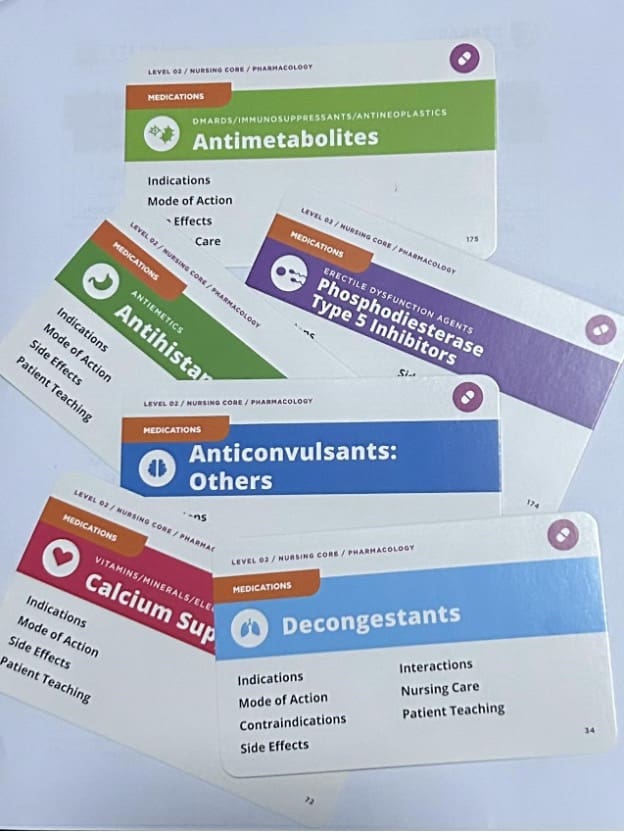
This course provides a strong foundation in the principles of pharmacology including pharmacodynamics and pharmacokinetics. Using your knowledge of medical terminology and applying what you learned about the body systems in the previous course, you will learn which prescription and non-prescription medications are commonly used in Canada to treat diseases affecting each body system. The content covered in this course is continually reinforced throughout the program.
Law & Ethics
In this course, you will learn how to apply Provincial and Federal legislation to practice competently within the professional practice framework. You will also learn to apply the ethical principles in pharmacy practice, ensure professional responsibility for delivering patient care, and understand the requirements to become a registrant and uphold pharmacy practice standards by remaining current with regulations and continuing education.
Professional Practice, Communication, and Patient Care
In this course you will develop the necessary communication skills to function as a competent and compassionate health care professional in a pharmacy setting. You will receive an introduction to basic communication concepts and develop skills to help you identify patients' unique needs, goals, and preferences. You will become familiar with the pharmacy technician's scope of practice and principles of professionalism for pharmacy to prepare you for the applied courses. Following an introduction to the social determinants of health, you will learn how to contribute to the development of culturally and emotionally safe spaces by promoting equity, diversity, and inclusion. You will also develop techniques to build effective interpersonal and collaborative relationships with members of the intra- and inter-professional health teams. You will learn how to cultivate resilience and well-being in yourself and others to maintain quality care for patients.
Community Pharmacy Operations and Dispensing
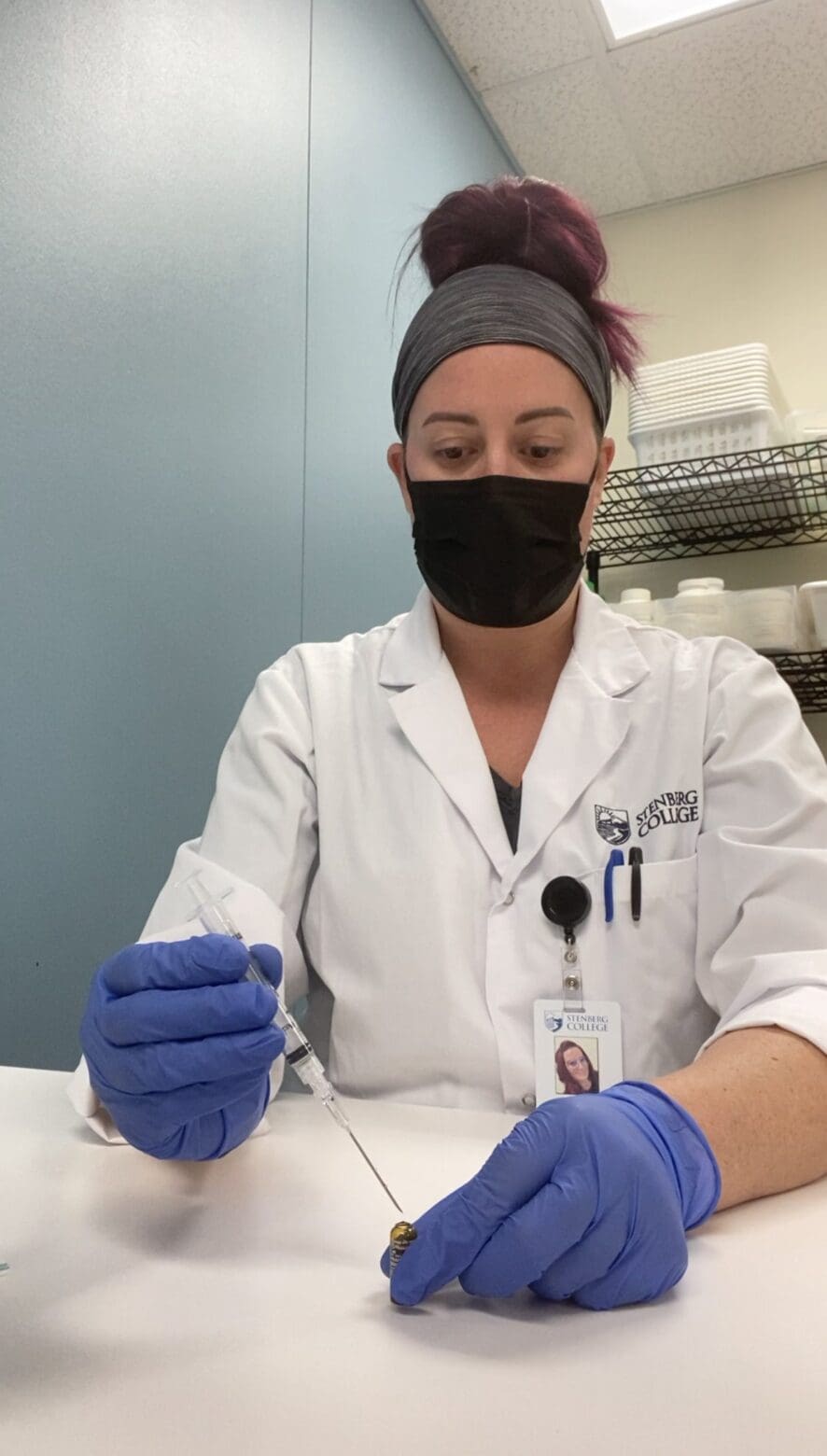
This course introduces students to community pharmacy operations and dispensing. You will learn about the different types of pharmacies, the services they provide, how they operate, and the roles of the pharmacist, pharmacy technician, and pharmacy assistant. You will examine common drug plans and their formularies, adjudication challenges, inventory management elements, and common business practices in community pharmacies. You will learn the theory to compounding non-sterile products using correct compounding techniques and apply professional guidelines, standards and legislation, pharmaceutical calculations, and documentation requirements associated with compounding. In pharmacy practices within the scope of practice of pharmacy technicians, you will learn to apply corresponding quality assurance and independent-double-check procedures for the preparation of non-sterile products. You will also learn how to administer vaccinations and medication by injection and other routes. You will learn to receive a prescription from a patient, collect demographic and other required information in order to fill a prescription, and list the steps required to prepare the prescription (including retrieval from inventory, adjudication of the prescription, performing required calculations, and ensuring safety procedures are followed). You will also learn to apply the correct auxiliary labels on medication products that are to be dispensed, supply the correct supplemental patient information, inform patients of the storage requirements, apply quality assurance measures, and practice within the regulated scope of a pharmacy technician or pharmacy assistant. You will also learn to appropriately assist clients who are purchasing non-prescription drugs for self-treatment of common disorders and when to collaborate with a pharmacist and/or refer the patient to the pharmacist for further consultation.
Community Pharmacy Operations and Dispensing Lab
This course introduces students to community pharmacy operations and dispensing. You will apply the theoretical knowledge learned in the theory course to simulated lab activities in accordance with the NAPRA competencies and CPTEA educational outcomes. You will demonstrate your knowledge of law and ethics as it pertains to pharmacy practice and follow the legal requirements for filling prescriptions. You will be expected to demonstrate competency in filling and checking prescriptions before dispensing, including non-sterile compounded prescriptions and compliance packaging. As a student, you will demonstrate the use of different devices used to deliver medications and/or monitor health conditions, such as glucometers and blood pressure monitors. You will also demonstrate how to teach a patient to use these devices using proper communication skills to ensure patient compliance and safety. You will learn to communicate patient data accurately to other healthcare professionals within the patient's circle of care, and receive patient information, to provide holistic care. You will also learn and demonstrate how to administer vaccinations and medication by injection and other routes.
Hospital Pharmacy Operations and Dispensing
In this course, you will review calculations required for preparing medications (sterile and non-sterile), learn how to prepare sterile products using aseptic technique, and learn about the different types of rooms and PECs used in preparation of sterile products and labeling of parenteral drugs. You will learn the theoretical concepts of compounding sterile products in a Laminar Air Flow Workbench using proper aseptic techniques. You will also learn to use applicable quality assurance and independent-double-check procedures for the preparation of sterile products. You will learn about the different drug distribution systems used to dispense drugs in a hospital environment for patients on various nursing wards, following proper policies and procedures, and using appropriate equipment and computer systems. You will also learn the legal requirements and procedures for delivering or retrieving narcotics from a nursing ward. You will learn to interpret and transcribe handwritten medication orders from doctors and perform order entry of medication orders manually on medication administration records. You will be required to use your pharmacology knowledge and communication skills and demonstrate your knowledge of law and ethics.
Hospital Pharmacy Operations and Dispensing Lab
In this course, you will develop the skills needed for the calculation, mixing, and labeling of parenteral drugs. You will learn to compound sterile products in a Laminar Air Flow Workbench using proper aseptic techniques. You will also learn to use applicable quality assurance and independent-double-check procedures for the preparation of sterile products. You will learn to dispense drugs in a hospital environment for patients on various nursing wards, following proper policies and procedures and using appropriate equipment and computer systems. You will also learn the legal requirements and procedures for delivering or retrieving narcotics from a nursing ward. You will learn to interpret and transcribe handwritten medication orders from doctors and perform order entry of medication orders manually on medication administration records. You will be required to use your pharmacology knowledge and communication skills, and you will also demonstrate your knowledge of law and ethics as they pertain to the hospital pharmacy environment.
Career Search Strategies
This course will teach you to network effectively (online and in-person), search and apply for jobs, and prepare targeted resumes and cover letters. You will receive coaching and individualized instructor feedback on your resume, cover letter, and interview skills.
Entry to Practice Preparation
This course will include a review of key theoretical and practical knowledge. You will receive information on test-taking skills to help you prepare for the licensing exam and write a comprehensive program exam. Finally, you will be asked to evaluate your overall educational experience (clinical and didactic), so the program may be improved in relation to your feedback.
Community Practicum
During your community practicum (also referred to as a Consolidated Practice Experience), you'll be assigned to a community pharmacy where you'll be supervised one-on-one by an experienced registered Pharmacy Technician or Pharmacist. This will give you an opportunity to implement your skills and theoretical knowledge in a professional setting.
Hospital Practicum
During your hospital practicum (also referred to as a Consolidated Practice Experience), you'll be assigned to a hospital pharmacy where you'll be supervised one-on-one by an experienced registered Pharmacy Technician or Pharmacist. This will give you an opportunity to implement your skills and theoretical knowledge in a professional setting.
Personal and Professional Development Skills Certificate
The Personal and Professional Development (PPD) Skills Certificate is a combination of interactive, online modules and synchronous follow-up discussions that apply the general module content to the specifics of your program and future career. In addition to the Soft Skills Development module, you will develop your ability to work with diverse clients, patients, and colleagues through the Gender Diversity and Sexual Orientation; Disability, Neurodiversity, and Accessibility; Anti-Indigenous Racism Response and Indigenous Gender Diversity; and Anti-Racism modules.
Provincial Violence Prevention Certification
The Provincial Violence Prevention Training Curriculum will teach you to recognize and respond to violent situations and learn about different types of violence and strategies for dealing with the risks in a variety of health care contexts. The Provincial Violence Prevention Curriculum has been developed by a team of experts from Worksafe BC, the Occupational Health & Safety Agency for Healthcare in BC, and various BC health authorities and healthcare unions. This training and certification is offered in collaboration with Fraser Health Authority.
Workplace Hazardous Materials Information System
WHMIS provides information about materials in the workplace that can be hazardous, such as cleaning agents, compressed gasses, and flammable materials. Becoming WHMIS certified will demonstrate the ability to identify hazardous materials and handle them properly.
Fit Testing
This theory course will cover the correct use and care of respirators, respirator limitations, donning and doffing procedures, and proper disposal of respirators in accordance with WorkSafeBC OHS Regulation Section 8.7.3.
Student Support
- Academic tutoring
- Assessment and skill development support
- Open study skills tutorials
- Typing practice support
- One-on-one student support coaching sessions
- English language learning support
- Online learning resources
- Online academic journals and databases
- Campus life events
Stories from our Pharmacy Technician grads


Loading stories...
Ask a Program Advisor
I understand that by submitting this form, I agree to receive periodic emails, phone calls and text messages (SMS) from Stenberg College. See our Privacy Policy. At any time you can opt out of SMS messaging by replying STOP. See our SMS Terms. Message and data rates may apply.
We're Here to Help
Our admissions advisors are here to help you find the right program and navigate your path to a rewarding career.
I understand that by submitting this form, I agree to receive periodic emails, phone calls and text messages (SMS) from Stenberg College. See our Privacy Policy. At any time you can opt out of SMS messaging by replying STOP. See our SMS Terms. Message and data rates may apply.
We're Here to Help
Our admissions advisors are here to help you find the right program and navigate your path to a rewarding career.
We use cookies to improve your experience and personalize ads. See our Privacy Policy.